Keeping a business compliant can become much harder once a company starts operating in more than one state.
A business may need registered agents in different jurisdictions, annual reports, foreign qualifications, business licenses, and a system for tracking deadlines.
Harbor Compliance is built around this particular challenge.
Rather than positioning itself primarily as a basic LLC filing company, Harbor Compliance focuses heavily on business compliance, registered agent services, licensing, entity management, and state registrations. It can help businesses handle some of the administrative work that comes with maintaining operations across different jurisdictions.
The platform can also help entrepreneurs establish new business entities, making it possible to use the company from formation through ongoing compliance.
This approach makes Harbor Compliance somewhat different from formation providers that concentrate mainly on helping individuals create an LLC at the lowest possible upfront price.
For a simple business operating in one state, many of its services may not be necessary. But for companies dealing with multiple states, licenses, registrations, or recurring compliance obligations, its specialized approach can be more relevant.
In this Harbor Compliance review, we will look at its business formation services, pricing, registered agent service, annual reports, foreign qualification, business licensing, compliance management, customer support, pros and cons, and who should consider using the platform.
What Is Harbor Compliance?
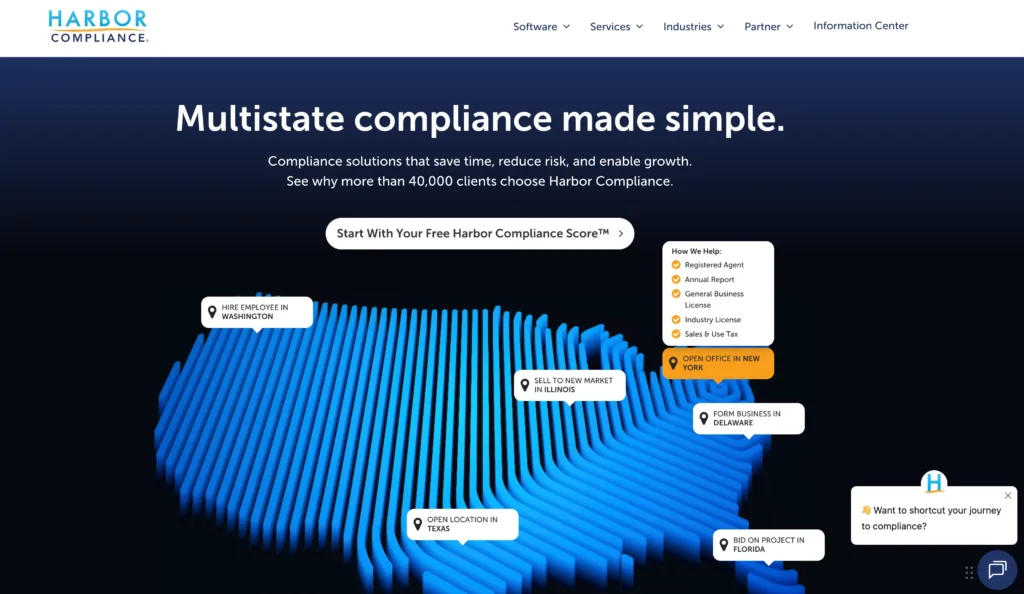
Harbor Compliance is a business compliance company that provides services designed to help organizations manage regulatory and administrative requirements.
Its services cover more than simply creating an LLC. Businesses can use Harbor Compliance for areas such as:
- LLC formation
- Corporation formation
- Registered agent services
- Annual report filing
- Foreign qualification
- Business licensing
- License management
- Compliance monitoring
- Entity management
- State registrations
The company’s focus makes it particularly relevant to organizations that have ongoing compliance responsibilities.
Harbor Compliance for Small Businesses
Small businesses can use Harbor Compliance for basic formation and registered agent requirements.
However, its services can become more useful as the business grows and takes on additional obligations.
A company expanding into another state, for example, may need to deal with foreign qualification, a new registered agent, annual filings, and potentially additional licenses.
Managing these requirements independently can take considerable time.
Harbor Compliance for Multi-State Businesses
Multi-state operations are one of the situations where a compliance-focused provider can be useful.
A company operating in several states may have different:
- Filing deadlines
- Registered agent requirements
- Licensing rules
- Annual reports
- State registrations
- Renewal requirements
Harbor Compliance provides services designed to help organize these responsibilities.
Harbor Compliance Business Formation
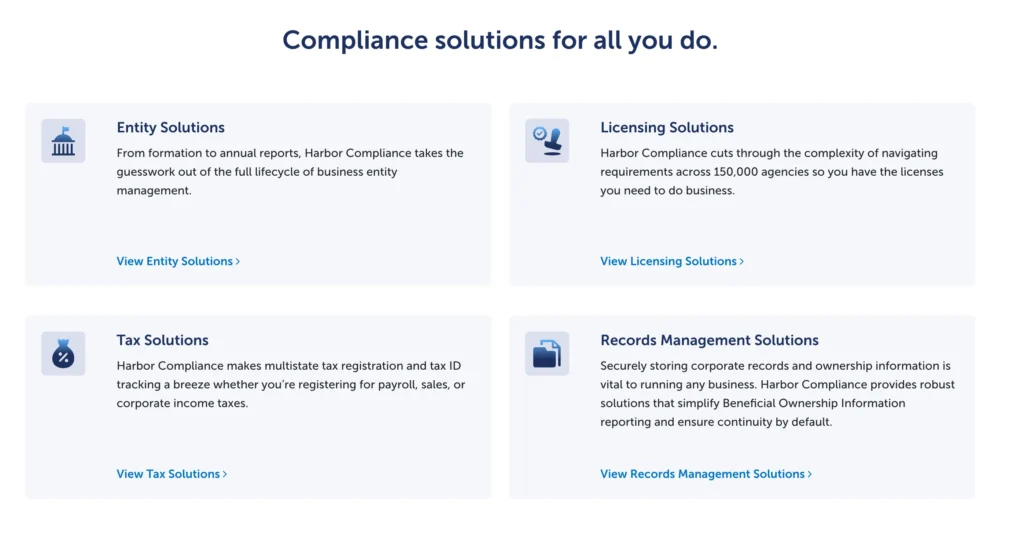
Harbor Compliance offers formation services for entrepreneurs and organizations establishing LLCs and corporations.
The service can help with preparing and submitting the necessary formation documents to the relevant state.
How Does Harbor Compliance Work?
The general formation process involves:
- Select the business structure.
- Choose the state.
- Provide the required company information.
- Review the formation requirements.
- Select the services you need.
- Submit the formation request.
- Harbor Compliance prepares the required paperwork.
- The documents are filed with the appropriate state agency.
- Receive the completed formation documents.
The state remains responsible for approving the business formation, so processing times can vary by jurisdiction.
Business Name Availability
A suitable business name is required when forming an LLC or corporation.
Harbor Compliance can assist with the formation process and related state requirements.
Business owners should remember that registering a company name with the state does not automatically provide trademark protection. A separate trademark search may be appropriate for businesses planning to build a long-term brand.
Harbor Compliance Pricing
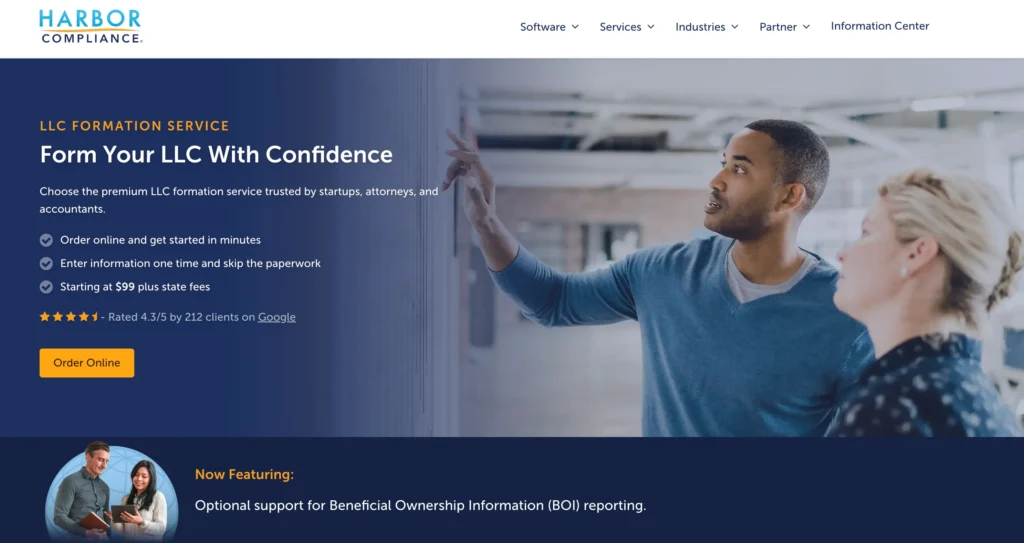
Harbor Compliance offers professional LLC formation services starting at $99 plus applicable state filing fees.
The company focuses on helping entrepreneurs, startups, and established businesses complete the LLC formation process with less paperwork and administrative effort.
Unlike some LLC formation providers that advertise multiple pricing tiers, Harbor Compliance highlights a starting price of $99 for its LLC formation service.
Additional costs may apply depending on the state and any optional services selected.
| Features | Harbor Compliance |
|---|---|
| LLC Formation Starting Price | $99 |
| State Filing Fees | Additional |
| Online LLC Formation | Available |
| Business Formation Assistance | Available |
| Streamlined Paperwork Process | Yes |
| Beneficial Ownership Information (BOI) Reporting Support | Optional |
| Additional Services | May cost extra |
State government filing fees are separate from Harbor Compliance’s service charges.
Formation Cost
The total cost of establishing a business depends on several factors.
These can include:
- Harbor Compliance service fee
- State formation fee
- Registered agent service
- Business license requirements
- Foreign qualification
- Other compliance services
A business with straightforward requirements may have a much lower total cost than an organization operating across several states.
Recurring Costs
Recurring expenses are particularly important when evaluating compliance services.
Registered agent service, annual report assistance, license management, and other compliance products can require ongoing payments.
Before signing up, determine which services you need immediately and which ones will continue to be necessary in future years.
Harbor Compliance Registered Agent Service
Registered agent service is a major part of Harbor Compliance’s offering.
A registered agent receives official documents and certain government correspondence on behalf of a business.
These documents can include:
- Service of process
- Government notices
- State correspondence
- Compliance documents
Why Use a Professional Registered Agent?
Business owners can often act as their own registered agent if they meet the applicable state requirements.
However, this means maintaining the required address and being available to receive official documents.
A professional registered agent takes over this responsibility.
For companies operating in multiple states, using one provider can also make it easier to manage registered agent requirements across different jurisdictions.
Harbor Compliance Annual Report Services
Many states require LLCs and corporations to submit recurring reports.
These filings may require businesses to confirm or update information such as:
- Company address
- Ownership information
- Management details
- Registered agent information
Missing a required filing can create additional administrative problems.
Harbor Compliance provides annual report services intended to help businesses track and complete these recurring obligations.
How Annual Report Assistance Helps
Depending on the service, businesses may receive help with:
- Tracking deadlines
- Preparing filings
- Submitting reports
- Monitoring requirements
- Maintaining compliance records
This can be particularly useful when a business has several entities or operates across multiple states.
Harbor Compliance Foreign Qualification
Foreign qualification becomes relevant when a business formed in one state needs to register to conduct business in another state.
For example, an LLC created in one state may later expand its operations into another jurisdiction and become subject to that state’s registration requirements.
Harbor Compliance offers foreign qualification services to help businesses manage this process.
When Might Foreign Qualification Be Necessary?
The rules differ by state, but factors can include:
- Physical business operations
- Employees
- Offices
- Revenue-generating activities
- Ongoing business activity in another state
Because the definition of doing business varies, companies should determine whether registration is actually required before filing.
Harbor Compliance Business Licensing
Business licenses are another major area covered by Harbor Compliance.
Forming an LLC does not automatically give a company permission to perform every type of business activity.
Licensing requirements can exist at different levels, including:
- State
- County
- City
- Industry-specific authorities
Why Is License Management Important?
A company may have several licenses with different renewal dates.
This becomes more difficult when the business operates in multiple states or has locations in different jurisdictions.
Harbor Compliance provides licensing services designed to help organizations identify, manage, and monitor these requirements.
This can be especially relevant to businesses in regulated industries.
Harbor Compliance Entity Management
Managing multiple business entities can create a significant administrative workload.
A company may have several LLCs, corporations, registrations, registered agents, licenses, and filing deadlines.
Harbor Compliance provides entity management services intended to help organizations keep these details organized.
This can be useful for:
- Companies with multiple subsidiaries
- Multi-state businesses
- Growing organizations
- Businesses with multiple registrations
A small company with one straightforward LLC may have little need for this level of management.
Harbor Compliance for Multi-State Operations
Expanding into another state can introduce new administrative requirements.
A company may need to consider:
- Foreign qualification
- Registered agent service
- State annual reports
- Business licenses
- Local registrations
- State fees
The challenge is not necessarily completing one filing. It is keeping track of all the requirements over time.
Harbor Compliance’s services are designed around this type of ongoing management.
Is Harbor Compliance Easy to Use?
Harbor Compliance is more compliance-oriented than many consumer-focused LLC formation websites.
The platform is designed for businesses that may have several regulatory responsibilities to manage.
The basic workflow involves:
- Identifying the applicable requirements
- Selecting the necessary services
- Providing company information
- Completing filings
- Monitoring ongoing obligations
For a business with multiple compliance requirements, having these services organized through one provider can be convenient.
For someone simply looking to create a single-member LLC, the platform may feel more extensive than necessary.
Harbor Compliance Customer Support
Compliance questions can be more complicated than basic formation questions.
A business may need assistance understanding a filing deadline, registered agent requirement, license renewal, or state registration.
Harbor Compliance provides support related to its compliance and business services.
Customers may need help with:
- Business formation
- Registered agent services
- Annual reports
- Foreign qualification
- Licensing
- Compliance management
For legal interpretation, tax advice, or highly specialized regulatory matters, businesses may still need to consult an attorney, accountant, or other qualified professional.
Harbor Compliance Privacy
A professional registered agent can provide a business address for certain official correspondence.
This may be useful for entrepreneurs who operate from home or businesses that do not have a traditional office.
However, registered agent service does not make every piece of company information private.
State laws determine which information is part of the public record.
Businesses concerned about privacy should review the disclosure requirements that apply in each jurisdiction where they operate.
Harbor Compliance Pros and Cons
Pros
- LLC and corporation formation
- Strong compliance focus
- Registered agent services
- Annual report assistance
- Foreign qualification
- Business licensing services
- License management
- Entity management
- Multi-state compliance support
- Useful for growing organizations
Cons
- May offer more services than a simple LLC needs
- State filing fees are separate
- Additional services increase total costs
- Recurring compliance fees can add up
- Less focused on branding and website tools
- Complex legal matters may still require an attorney
Who Should Use Harbor Compliance?
Harbor Compliance can be particularly useful when a business has multiple compliance responsibilities.
Multi-State Businesses
Companies operating across several states may benefit from centralized registered agent, filing, and compliance support.
Growing Companies
As businesses expand, keeping track of additional entities and registrations can become more difficult.
Licensed Businesses
Companies that need professional or industry-specific licenses may find dedicated license management useful.
Organizations With Multiple Entities
Businesses with several LLCs or corporations can use entity management services to keep registrations and compliance requirements organized.
Who May Not Need Harbor Compliance?
Harbor Compliance may not be necessary for every entrepreneur.
A single-member LLC operating locally in one state may have relatively straightforward requirements that the owner can manage independently.
It may also be unnecessary if you already work with:
- An attorney
- An accountant
- An internal compliance team
- A registered agent
- Compliance software
In those situations, paying for an additional compliance provider may not provide enough value.
Harbor Compliance vs DIY Compliance
A business owner can handle many compliance tasks independently.
This may involve:
- Filing formation documents
- Maintaining a registered agent
- Filing annual reports
- Applying for licenses
- Tracking renewal dates
- Registering in additional states
For a simple business, this may be manageable.
As the number of states, licenses, and entities increases, however, the administrative workload can grow quickly.
Harbor Compliance provides services for businesses that prefer to outsource some of this work.
Is Harbor Compliance Worth It?
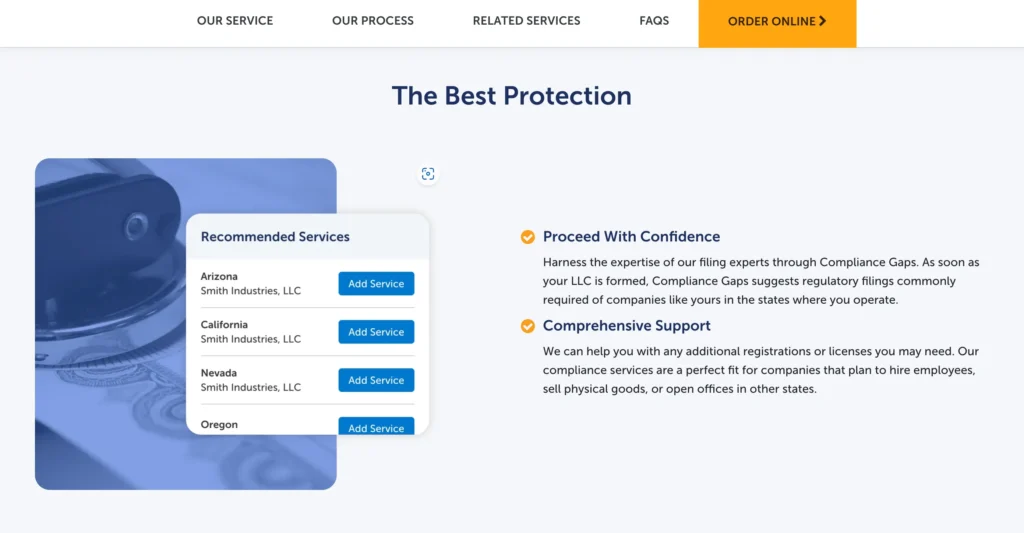
The value of Harbor Compliance depends largely on the complexity of your business.
For a basic LLC with limited obligations, paying for extensive compliance services may not be necessary.
For a company operating in multiple states, maintaining several entities, or managing numerous licenses, the situation is different. Having a centralized system for tracking requirements can save administrative time.
The best approach is to identify the specific compliance tasks your business needs and then compare the cost of handling them internally with the cost of outsourcing them.
Final Thoughts on Harbor Compliance
Harbor Compliance stands apart from many online business formation providers because compliance is at the center of its service offering.
The platform can help businesses with formation, registered agents, annual reports, foreign qualification, licensing, and entity management.
These services become particularly relevant when a company operates across multiple jurisdictions or has several regulatory obligations to track.
For a new entrepreneur creating one simple LLC, Harbor Compliance may offer more support than necessary. A business owner in that situation may only need basic formation and registered agent services.
For growing companies, however, compliance can become a recurring administrative responsibility rather than a one-time task. Harbor Compliance is designed to address that side of business ownership.
The cost should still be reviewed carefully. Service fees, state charges, registered agent costs, licensing services, and recurring compliance expenses can all contribute to the overall price.
End Note
Harbor Compliance is a specialized option for businesses that need help keeping registrations, licenses, filings, and other compliance responsibilities organized.
Its strongest use case is not simply forming an LLC. It is helping businesses manage the administrative requirements that can appear as they expand into additional states or operate under more complex licensing rules.